

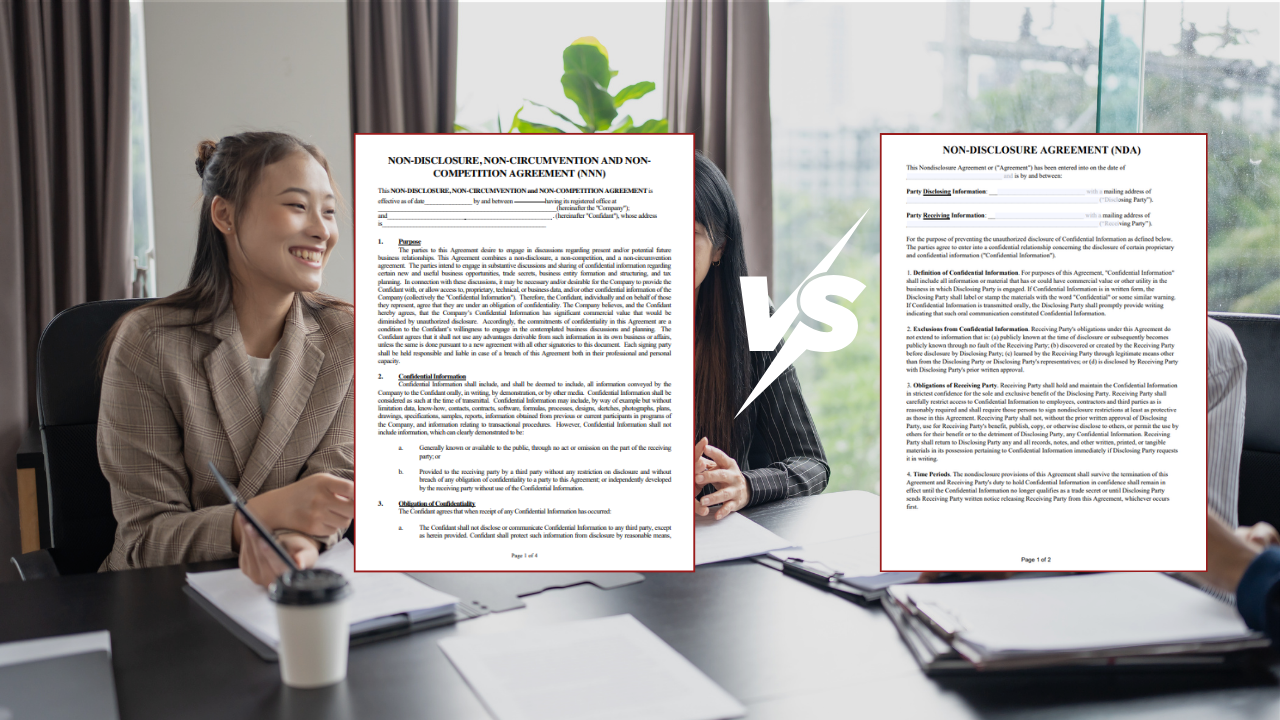
You just spent six months perfecting your prototype. You found a factory in Shenzhen that looks world-class. You sent them your CAD files. But first, you did the "smart" thing. You sent them your standard 5-page Non-Disclosure Agreement, governed by the laws of Delaware, written in perfect legalese. They signed it in ten minutes.
You feel safe. You shouldn't.
In reality, you just handed over your life’s work for free. To a Chinese manufacturer, that Western NDA is a souvenir. It’s a piece of paper with no teeth, no reach, and zero consequences. If they decide to launch your product under their own brand next Tuesday, your Delaware lawyer can’t help you.
Twenty years in this game has taught me one thing: China doesn't play by your rules. If you want to protect your IP, you stop playing "international businessman" and start playing by Chinese law. That means dumping the NDA and implementing a rock-solid NNN agreement in China.
The Fatal Flaw of the "International" NDA
Most importers are naive. They think "Contract Law" is a universal language. It isn't.
If your contract says disputes are settled in Los Angeles, you’ve already lost. China does not recognize or enforce foreign judgments from US or UK courts. Even if you win a $5 million judgment in California, you can’t take that piece of paper to a court in Guangdong and expect them to freeze the factory’s bank accounts. They will ignore it.
The factory knows this. That’s why they signed your NDA so fast. It’s a "Feel Good" document for foreigners. It keeps you quiet while they reverse-engineer your mold.
What is an NNN Agreement?
An NNN agreement is a different beast entirely. It stands for Non-Use, Non-Disclosure, and Non-Circumvention. It is designed specifically for the Chinese legal system. It is written in Chinese. It is governed by Chinese law. It is enforceable in Chinese courts.
1. Non-Use (The Core Problem)
The biggest threat in China isn't that a factory will tell your secrets to a competitor. It’s that they will use your designs themselves.
They have the molds. They have the supply chain. Why should they only be your "partner" when they can be your "competitor"? A standard Western NDA focuses on "secrecy." A Chinese NNN focuses on "prohibition of use." It explicitly states that the factory cannot use your IP to manufacture products for anyone—including themselves—without your express permission.
2. Non-Disclosure
This is the part you know, but with a Chinese twist. In China, "secrecy" isn't just about the blueprints. It’s about the "circle of knowledge." A factory might not tell a rival factory about your design, but they might "leak" it to a cousin who runs a trading company. Your NNN must make the factory liable for any disclosure within their entire network of sub-contractors and affiliates.
3. Non-Circumvention
This prevents the "End-Run." You spend years building a customer base. Your factory sees your shipping labels. They know exactly who your buyers are. Without a non-circumvention clause, the factory will wait until your order is finished, then contact your buyers directly and offer the same product for 20% less.
They cut you out. You’re dead. The NNN stops this.
Why Mandarin is Non-Negotiable
If your contract is in English, you’re gambling.
Chinese courts are overworked. Judges don't want to deal with translations. If there is a dispute, the court will appoint its own translator. You won't control the nuance. One misinterpreted verb can cost you your entire case.
A professional NNN agreement is a dual-language document where the Chinese version is the "controlling" version. This signals to the factory owner that you are serious. You aren't a tourist. You have local counsel. You know how the system works. This alone prevents 80% of IP theft. It makes you a "hard target."
The Hammer: Liquidated Damages
In a US court, you have to prove "actual damages." You have to show exactly how much money you lost because of a breach. That’s a nightmare to prove in a foreign country.
In China, we use Liquidated Damages.
This is a specific, pre-agreed dollar amount (or RMB amount) that the factory must pay if they break the contract. It’s a penalty. It’s the "Hammer."
When you set the liquidated damages at, say, $500,000, the factory owner does a calculation. "Is stealing this design worth a half-million dollar legal headache that will freeze my local accounts?" Usually, the answer is no.
Without a liquidated damages clause, you have no leverage. With it, you have a loaded gun.
Molds: The Physical IP
If you pay for the molds, you own them. Or you should.
In China, "possession is 10/10ths of the law." If your molds are in their factory and you haven't clearly defined ownership in your NNN and subsequent Manufacturing Agreement, they are their molds. They will hold them hostage the moment you try to move production to another facility.
- Mark your molds physically.
- Include mold ownership clauses in the NNN.
- Specify the right to remove molds at any time.
Don't let your assets become their leverage.
The "Good Guy" Trap
I hear it every week. "My supplier is different. Mr. Li and I had tea. We talked about his family. He’s a good guy."
Mr. Li is a businessman. He has 300 employees to pay and a mortgage. If his profit margin on your order is thin, but he can make a fortune selling your "excess" inventory out the back door, he will. Business in China is transactional, not emotional.
The NNN agreement isn't an insult to Mr. Li. It’s a boundary. In Chinese business culture, a strong contract is a sign of respect. It shows you are a high-level player who understands the game. If a supplier refuses to sign a Chinese-law NNN, walk away. They are telling you their intentions before you even start.
Strategic Timing: Sign Before You Talk
The most common mistake? Signing the NNN after you've sent the "general idea."
In China, there is no such thing as "preliminary negotiations" being protected. Once the info is out, it's public domain unless a contract says otherwise. You do not send a single CAD file, a single spec sheet, or even a detailed product description until that NNN is chopped (stamped) and signed.
The Reality of Enforcement
Is the NNN a magic shield? No. But it is a deterrent.
Chinese courts have actually become much more sophisticated regarding IP over the last decade. They want to show the world they are a "mature" market. If you have a contract that is:
- In Chinese.
- Under Chinese jurisdiction.
- Signed with the correct company chop.
- Includes liquidated damages.
You have a very high chance of winning in a local court. More importantly, you have a very high chance of the factory owner settling before it even gets to court. They don't want the "Credit Score" of their business to take a hit.
Summary: The Checklist for Success
Stop being an easy mark. Protect your investment.
- Forget US Law: Your California jurisdiction is a joke in Shenzhen.
- Mandarin First: If it isn't in Chinese, it isn't real.
- The Three Ns: Non-Use, Non-Disclosure, Non-Circumvention.
- Specific Penalties: Use liquidated damages to make a breach expensive.
- Official Chops: A signature means nothing; you need the official company seal (the "Chop").
- Register Your Trademark: An NNN is only half the battle. Register your brand in China before someone else does.
The "NNN agreement China" is the cost of doing business properly. You can spend $3,000 now on a real legal framework, or you can spend $300,000 later watching your product sell on Amazon under someone else's name.
Your move.